SPOKANE, WASH. — Governor Bob Ferguson’s proposal to require high school seniors to complete the Free Application for Federal Student Aid (FAFSA) has sparked questions and concerns among families. But financial aid experts say the requirement would not lock students into attending college and comes with important protections for those who choose not to pursue higher education.
Governor Ferguson’s proposal would require Washington high school seniors to complete the FAFSA, the form used to apply for federal and state financial aid for college. Completing the state-only aid form, the Washington Application for Student Financial Aid, would also satisfy the requirement.The FAFSA is not a loan, and families can opt out of the requirement entirely if they choose not to pursue college or federal aid.Education advocates say the requirement could help dispel myths about college affordability and help families make informed decisions about their futures.
The FAFSA allows students to apply for federal and state financial aid to help pay for college, trade school, an apprenticeship or other forms of higher education. A common misconception is that completing the form obligates students to attend college or take out loans. That’s not the case.
If families don’t want to apply for federal aid, they can instead apply for the WAFSA — Washington’s state financial aid application — which serves as an alternative.
The personal information requested on the FAFSA is nearly identical to what families already provide when filing taxes.
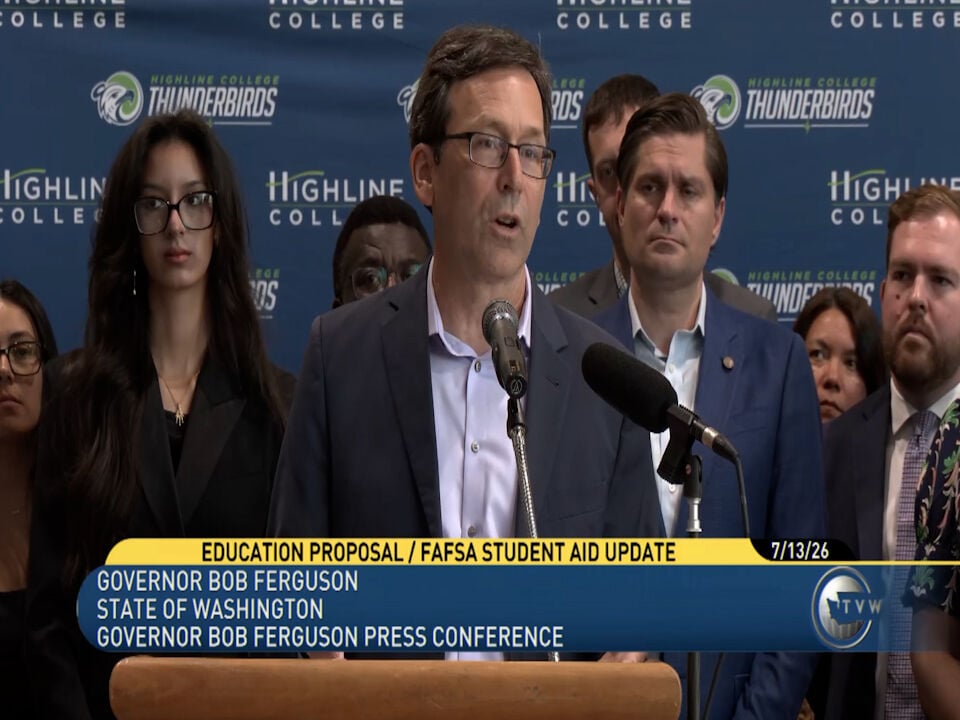
At a press conference earlier this week, Governor Ferguson said his proposal is meant to help students who want to continue their education, but don’t think they can afford it.
“By requiring this, that’s gonna require a conversation with young people all across the state. And they will learn about what’s possible here in Washington state,” Ferguson said.
Ashley DeLatour, executive director of programs at FuturesNW — a nonprofit organization that helps students reach higher education — supports the requirement, with an important caveat: students will need support to complete the form.
“I think, for a lot of families, they’re going to have that realization that what they’ve heard all along — that college is not affordable, that they won’t qualify for aid — is simply not true. So it’s really an effort to myth bust a lot of assumptions that are out there and to help people make an informed choice,” DeLatour said.
DeLatour also addressed concerns about the time commitment required to complete the application. Some families worry the form will take hours to finish, but she has seen completed it in as few as 10 minutes. She encourages families to seek help if needed.
“This is a free application. You should be able to get free support. So seek out those free resources for you to be able to complete this,” DeLatour said.
One resource DeLatour recommends for people in Eastern Washington and North Idaho is LaunchNW, a nonprofit that supports education and careers.
Filling out the FAFSA is not yet mandatory. The proposal will be considered during the next legislative session.
COPYRIGHT 2026 BY KXLY. ALL RIGHTS RESERVED. THIS MATERIAL MAY NOT BE PUBLISHED, BROADCAST, REWRITTEN OR REDISTRIBUTED.