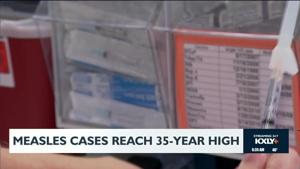
SPOKANE, Wash. — A disease once considered eliminated from the United States is making a dangerous comeback, with measles cases reaching levels not seen in more than three decades.
The Centers for Disease Control and Prevention reports 4,410 measles cases nationwide in 2026 — nearly double the 2,289 cases documented in 2025. In Washington state alone, 58 people have been diagnosed with measles this year, a dramatic increase from the previous year’s numbers.
The resurgence comes as vaccination rates continue to lag following pandemic-related declines. According to the Washington State Department of Health, immunization rates for all diseases dropped significantly during the height of the COVID-19 pandemic and have yet to fully recover.
“We’re nervous as pediatricians, truly,” said Dr. Sarah d’Hulst, a pediatrician and medical director of primary care at MultiCare. “Personally, and for many of my colleagues that are my age, we have never seen measles in real life because the vaccine is so effective.”
That lack of experience presents a real challenge for medical professionals. Despite her 25 years in practice, Dr. d’Hulst has never treated a measles patient, which can complicate diagnosis and delay treatment.
“It can be a challenge to get a quick diagnosis,” she explained. “We’re all aware that it exists, but with that lack of experience, there is a difficulty there in recognizing measles right away.”
The problem is particularly acute in Eastern Washington. Three counties — Pend Oreille at 82%, Stevens at 87%, and Ferry at 88% — rank among the state’s lowest for measles vaccination rates among kindergarten through 12th grade students. These figures fall well below Washington’s statewide average of 95%.
Ninety percent of measles cases nationwide are occurring among unvaccinated individuals.
Mark Springer, manager for communicable disease prevention at the Spokane Regional Health District, said the visible impact of measles is prompting some families to reconsider vaccination decisions.
“People are seeing the reality of this disease or these diseases and, you know, that’s leading many families to kind of reevaluating the risk,” Springer said.
The resurgence of measles comes amid recent changes to federal vaccine recommendations. The Department of Health and Human Services has modified recommendations for several vaccines, including those for influenza, COVID-19, and hepatitis, leaving some parents uncertain about which immunizations their children need.
However, Dr. d’Hulst emphasized that medical research supporting vaccine recommendations has not changed, even as federal guidance has evolved.
“The good thing, I think, is pediatricians and the American Academy of Pediatrics have not changed their stance on this at all,” she said. “It has really been an unwavering recommendation that we fully, fully vaccinate, just like we were doing before the pandemic.”
As vaccine skepticism grows — fueled partly by recent political changes affecting health policy — pediatricians are focused on rebuilding public confidence in immunizations. Dr. d’Hulst said the effort begins with reminding parents that doctors share their concerns about children’s health.
“We understand. We want what’s best for our kids, and we want what’s best for your kids. That’s our whole goal in life,” she said. “Most pediatricians did not go into this for any reason other than we love kids and families, and we want to do what’s best.”
COPYRIGHT 2026 BY KXLY. ALL RIGHTS RESERVED. THIS MATERIAL MAY NOT BE PUBLISHED, BROADCAST, REWRITTEN OR REDISTRIBUTED.