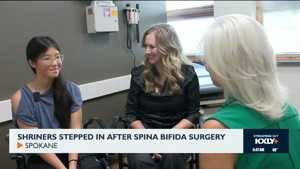
SPOKANE, Wash- Gladys Miller knows falling is part of the journey.
“Walking was very challenging. It’s still kind of challenging,” the 17-year-old said. “I fall a lot.”
But Miller gets back up.
The Kellogg High School student has received care through Shriners for about a decade, beginning after Amy Miller and her husband adopted her from China. Gladys was born with spina bifida and underwent spinal surgery in China. She said the procedure damaged nerves in her left leg, leaving her with limited control over it.
“I have limited control of it,” Gladys said. “Sitting, I can’t move it.”
A Shriners surgeon worked to reduce the difference in length between Miller’s legs. Her mother said Gladys had surgery on her stronger leg to slow its growth and allow the other leg to catch up.
The discrepancy that was once roughly 1 1/2 to 2 inches is now only a couple of centimeters, Amy Miller said.
Gladys also used a leg brace with a hinge she had to unlock by hand to bend her knee before sitting or leaning over. The brace would lock again once she stood upright.
Even with those challenges, she joined Kellogg High School’s golf team — knowing a fall at the tee box was possible on every drive.
A Shriners prosthetist who had worked with Gladys learned about a newer option and thought of her: a microprocessor KAFO, short for knee-ankle-foot orthosis.
The advanced, computer-controlled leg brace uses sensors to track movement in real time and adjust resistance at the knee. Gladys and her Shriners care team have been adjusting settings through a companion app since she received it in May.
One setting can lock her knee in place, which Gladys said gives her more stability while golfing.
“If I’m in basic mode and I bend my knee and then click on the freeze position, it will lock it and I cannot move at all,” she said. “That is very helpful for the drive.”
Prosthetist and orthotist Nathan Shimabukuro said Gladys is the first Shriners patient to receive the technology.
“Gladys is our experiment — and it worked out,” Shimabukuro said. “It took us a while to really find justification, just to make sure we’re providing exactly what’s needed for her.”
The brace costs more than $40,000. Amy Miller said the family’s insurance denied coverage twice, and Shriners appealed on their behalf.
“Shriners asked us to write letters. Shriners wrote letters,” she said.
The effort ultimately paid off. Amy Miller said Shriners has been vital to their family and that she is not sure the technology would have been offered elsewhere to someone Gladys’ age.
For Gladys, the brace represents another step toward the independence she wants as she moves into adulthood.
“As she moves on in life, independence — she’ll feel like she doesn’t need to rely on Mom and Dad as much,” Amy Miller said.
The Shriners telethon is Wednesday, Sept. 16. You can donate now on KXLY’s Shriners donation page.
COPYRIGHT 2026 BY KXLY. ALL RIGHTS RESERVED. THIS MATERIAL MAY NOT BE PUBLISHED, BROADCAST, REWRITTEN OR REDISTRIBUTED.