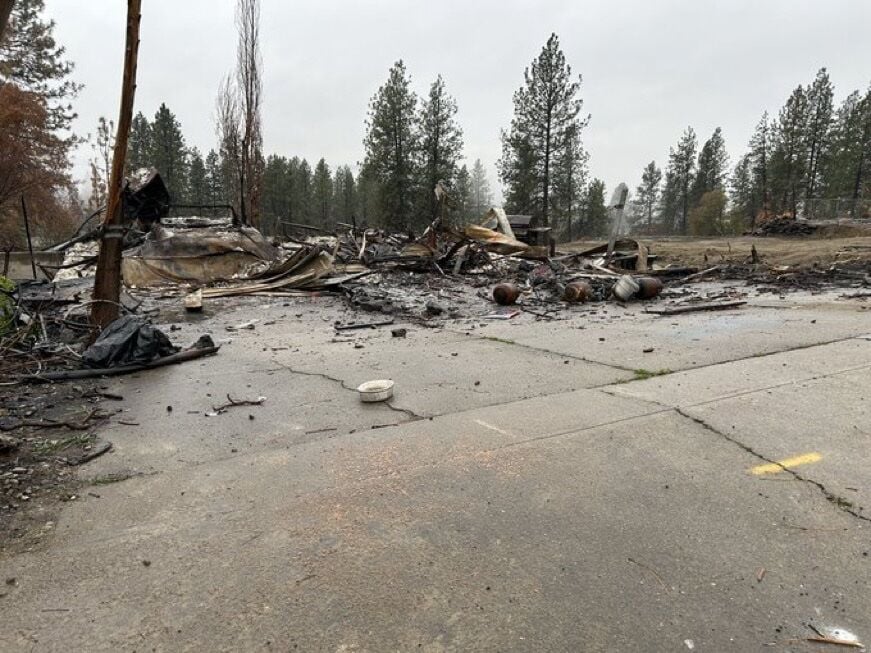
SPOKANE COUNTY, Wash. — More than three months after the Spokane Complex Fires first broke out, rebuilding is underway for some of the people who lost homes. Officials from the Department of Natural Resources and local firefighters are now reviewing how the fire season was handled across the state.
Washington Commissioner of Public Lands Dave Upthegrove described the scale of the damage across the state.
“We saw nearly 1,000 homes destroyed from the Colville Reservation, to Okanogan and most notably here in Spokane. We saw 65,000 people in our state’s second-largest city have to evacuate,” Upthegrove said.
Upthegrove said the Department of Natural Resources used anti-drone technology for the first time during the Spokane Complex Fires. As many as 60 drones were interfering with aircraft being used to fight the fires.
Local fire officials are already turning their attention to next fire season and what they can do to prepare. Lance Dahl, assistant fire chief for Spokane Fire, said the department’s fuel mitigation work is making progress but is far from finished.
“I’m pretty proud of our fuel mitigation program. We’ve done about 2,100 acres in the last three years. That sounds like a lot, but we’re only about half done with the work that we need to do and then expand that work out into our partnerships,” Dahl said.
Dahl’s comments show the scope of the work ahead. Fire officials also point to the area closest to a home, which they call the home ignition zone, as a priority for homeowners.
Fire District 3 Chief Cody Rohrbach said the risk of another large fire is real and homeowners need to act now.
“The next fire isn’t really a question of if, it’s when,” Rohrbach said, “so what this has reaffirmed for me is that these fires are going to continue to happen. There’s a lot we can do as a community to remain resilient.”
Rohrbach said the first five to 10 feet around a home can make a major difference, and the building materials used on a home also play a role.
“That first 5-10 feet can make a huge difference, and then the building materials we’re using can have a big impact,” Rohrbach said, “but really the first part of that is how do we affect immediately around the home in what we call the home ignition zone.”
Rohrbach hopes homeowners will take time to identify anything flammable on their property, including pine needles, leaves and dry grass, before next spring. Cleaning up the area closest to a home can keep a spark from spreading to the structure.
COPYRIGHT 2026 BY KXLY. ALL RIGHTS RESERVED. THIS MATERIAL MAY NOT BE PUBLISHED, BROADCAST, REWRITTEN OR REDISTRIBUTED.