SPOKANE, Wash. — Before interstates and commercial air travel connected Spokane to the rest of the country, the railroads did. They moved people, freight and entire industries — and in doing so, helped shape the city that grew around them.
Today, the most visible remnants of Spokane’s railroad past can be seen in the Valley and from an elevated rail bridge visible from Sunset Boulevard. But these are mere fragments of the bustling rail system that built Spokane more than a century ago.
Trains first arrived in Spokane in 1873, eight years before the city was officially incorporated. The rail system would prove transformative, connecting Spokane to the rest of the country and bringing people, products and economic opportunity to a growing community.
“It became a hub of commerce from the East and helped settle the West. Without the railroads, it wouldn’t have happened,” said Dale Swant, president of the Inland Northwest Rail Museum.
Spokane’s geographic position made it an ideal railroad hub. The city sat at a crossroads for rail lines coming from the north, south, east and west. At its peak, five major railroads served Spokane, and as the railroads expanded, the city expanded around them.
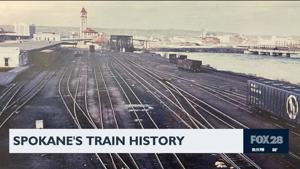
Nowhere was the railroad’s presence more obvious than downtown Spokane. The entire riverfront was once dominated by railroad infrastructure. “The entire riverfront park was nothing but railroad tracks,” Swant said. Depots, tracks and rail yards filled much of what is now Riverfront Park. The trains transported passengers, but their primary cargo was the grain, timber, minerals and other goods that drove the Inland Northwest economy.
Most of that railroad infrastructure disappeared as Spokane prepared for Expo ’74 in 1974. However, one significant piece remains: the Great Northern Clock Tower. If you look closely at the brick, you can see where the original structure ends and the rebuilt portion begins — a visible reminder of Spokane’s transition from rail yard to public park.
The railroad’s influence extended well beyond downtown. Hillyard grew around the Great Northern Railway’s massive repair and maintenance operations, which ranked among the largest west of the Mississippi River. James Hill strategically chose the location for his workshops outside the city limits to avoid taxation. The neighborhood that developed around these operations was eventually named after Hill — Hillyard — and at its peak, employed around 1,000 workers. “The town itself was built around the railroad,” Swant said. The shops even built steam locomotives, including some that ranked among the largest in the world at that time.
Near another former rail yard, Kendall Yards, the Centennial Trail now follows one of the main rail arteries that once brought trains into Spokane. Kendall Yards itself once housed a large roundhouse — a facility where trains could be turned in different directions for routing to various destinations.
By the late 1950s and 1960s, passenger rail began losing ground to air travel and the automobile. Today, passenger lines through Spokane are sparse, though freight rail remains the primary driver of rail traffic through the region. “All that grain that you see around here, it’s got to go somewhere,” Swant said. “And it goes on the railroad.”
At the Inland Northwest Rail Museum near Reardan, locomotives, passenger cars and other equipment from Spokane’s railroad era are being preserved for future generations. The collection includes the last existing Spokane streetcar. Swant emphasizes the importance of this preservation work. “Once this equipment is gone, the history is going to be gone. And if we can maintain that, we can tell the story of the railroads not just in Spokane, but the world.”
The steam locomotives are mostly gone. The downtown rail yards have transformed into Riverfront Park. But the railroad that helped build Spokane never completely left. Its tracks — and its legacy — still run through the city today.
COPYRIGHT 2026 BY KXLY. ALL RIGHTS RESERVED. THIS MATERIAL MAY NOT BE PUBLISHED, BROADCAST, REWRITTEN OR REDISTRIBUTED.