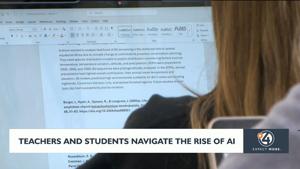
SPOKANE, Wash. – Artificial Intelligence is quickly becoming a fixture in everyday life, with its influence extending across social media, security, and even healthcare. Now, it’s making its mark in education, opening up new possibilities for students, teachers, and administrators alike.
The Spokane Public School District has embraced AI, recognizing both its perks and its flaws.
Marina Gruis, a humanities instructor at North Central High School, believes that using AI tools—such as ChatGPT—is similar to using a calculator. Students should solve math equations by themselves and show their work. When they’re done, it’s okay to use a calculator to check their answers.
But unlike a calculator, generative AI comes with no inherent limits, presenting a new set of challenges. Gruis emphasizes that AI must be used with caution, especially given its potential to deliver incorrect information.
“We also have to teach them the flaws of AI. It’s a very co-dependent relationship. It just wants to make you happy, and so it might even deliver you incorrect information,” said Gruis.
The rapid integration of AI into classrooms has prompted a shift in teaching strategies. Gruis, who knows her students well, can quickly discern when their writing is their own or when AI has taken the pen.
“I was like, ‘Whoa, whoa, whoa. I’m gonna throw this into an AI checker real quick. And so those are difficult conversations.”
To combat misuse, many teachers have reverted to traditional methods. Gruis and her colleague now require handwritten rough drafts for all assignments, a strategy that allows them to check students’ work in real-time.
Spokane Public Schools has also implemented district-wide measures to track and block AI use on school computers. The district also has its own classroom-friendly AI tool that it can manage.
Michelle Meek, a library information specialist in the district, plays a pivotal role in teaching digital citizenship and media literacy, helping students navigate the complexities of AI. For her, AI is now a crucial component of the curriculum.
“There is a thread of AI now that is added onto everything that librarians and schools talk about,” Meek said.
Both educators agree that while AI brings challenges, it also offers valuable opportunities. Gruis notes that AI has revitalized her teaching, eliminating some of the more tedious aspects of lesson planning, thus giving her more time to focus on engaging students.
“As a teacher, it’s made teaching fun again. Because it’s like all those things I haven’t had time to do, I now have time because it eliminates a lot of the heavy lifting.”
For students, the technology opens up new avenues for exploration. Meek points out that middle schoolers especially enjoy the chance to identify AI-generated images. “They do like to kind of challenge and question and argue, so anything that gets them doing that is engaging for middle schoolers.”
But as both teachers stress, with the great power of AI comes great responsibility. It’s a lesson that Spokane educators are determined to impart to their students, making sure they understand both the potential and the pitfalls of the rapidly advancing technology.
COPYRIGHT 2025 BY KXLY. ALL RIGHTS RESERVED. THIS MATERIAL MAY NOT BE PUBLISHED, BROADCAST, REWRITTEN OR REDISTRIBUTED.