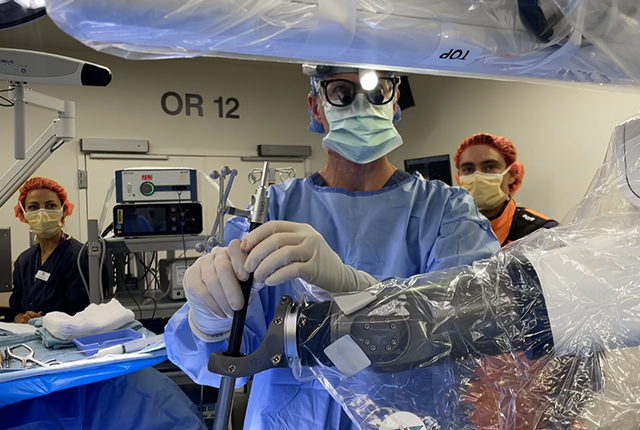
SPOKANE, Wash. — More surgeons are now working with robotic-assisted tools to help improve patient recovery times.
Orthopedic surgeon Richard Bransford, of UW Medicine*, specializes in spine and back procedures. One of the most common issues people experience is degenerative, or “slipped” discs in their spine. The condition can be incredibly painful, and surgical intervention is often the last resort, due to insurance requirements that force patients and their doctors to try less expensive and invasive procedures. Patients often have to endure bouts of physical therapy, targeted epidural anesthetics and other alternatives before surgery is considered.
Robotic-assisted equipment involves making the smallest incisions possible and using laser-focused equipment and cameras through a tube to correct certain back and spine issues.
“We’ve been using navigation and spine surgery for a while, but what the robot allows us to do is to very precisely find that angle and navigate that angle,” Bransford said. “The robot arm can kind of tell us where to place that screw, which the study suggests is a more accurate, and therefore more effective, tool.”
Because the minimally invasive spine surgeries require such small incisions, there is less tissue trauma and pain for the patient, resulting in faster recovery times.
Dr. Bransford said it’s important for surgeons to stay on the cutting edge of technology and practice with robotic-assist surgical tools.
“What this means for Harborview is that not only can we ideally do a better job taking care of patients, but also to train our medical students, residents, fellows, the next generation of surgeons,” Bransford said.
*The information in this article was provided as handout material from UW Medicine.
COPYRIGHT 2024 BY KXLY. ALL RIGHTS RESERVED. THIS MATERIAL MAY NOT BE PUBLISHED, BROADCAST, REWRITTEN OR REDISTRIBUTED.