SPOKANE COUNTY, Wash. — Washington voters will get their ballots in the mail by next week, but voting can be a long and complicated process.
Now, imagine trying to vote and not understanding your ballot. This is a reality for many here in Eastern Washington.
“I learned that people were not voting because there were barriers to voting,” said Susan Hales with the League of Women Voters of Spokane Area.
The League of Women Voters is a nonpartisan, grassroots organization that works to protect and expand voting rights.
“I’ve been receiving these envelopes at my home. They are there, but i did not understand them,” said Justin Kanumuna, a first-time voter.
Justin is from the Democratic Republic of the Congo and has been in the U.S. for more than five years. This is the first time he can vote.
He’ll do so in English, not his native Swahili, on a ballot that isn’t translated.
While the state of Washington has voter registration forms in over 20-languages, the ballots in Spokane county are only in English.
According to the Voting Rights Act, “cities or counties must translate ballots and other voting information if more than 10,000 people or 5% of the voting-age citizens who speak that other language have low literacy rates and don’t speak English well.”
In Spokane County, no specific community meets that criteria. So here, ballots are translated.
“I brought that to the attention of our local league of women voters, and we decided that we would get translated sample ballots,” said Hales.
This year, the Spokane chapter translated the county’s general election ballots into Arabic, Spanish, Dari, Kinyarwanda, Swahili, Russian, Ukrainian, Vietnamese and Chinese.
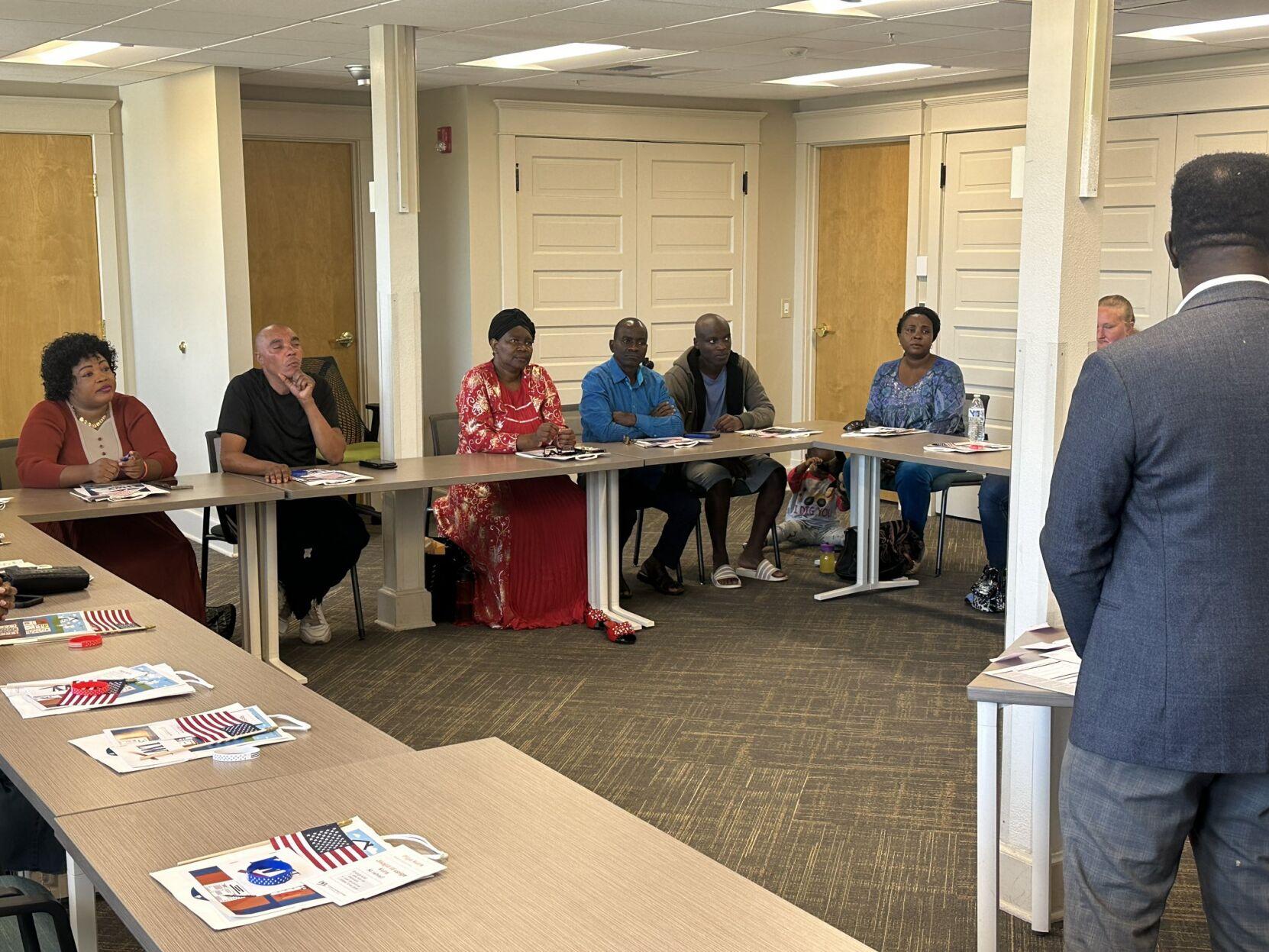
It also partnered with other local organizations to host workshops for immigrants and refugees. Translators were there to help.
One workshop was done in Swahili, for people like Justin.
The workshops cover everything from how to register to vote, how to seal your ballot in the envelope, what ballot drop boxes are, and more.
“When it comes to the language that is not yours, you have to make sure that they take you through the process like what we did today. It has made me understand quite well what I have to do when it comes to November 5,” said Justin Kanumuna.
The league also partnered with the local non-profit Manzanita House to host workshops. One being in Spanish.
Pia Barreto was one of the participants at the workshop. She moved to the United States from Peru in 2017. She’ll be voting in her first presidential election this year.
“It’s great to hear about like the challenges of voting, how to overcome those challenges…what pieces of information are required. Even just to look at your voters’ pamphlets, which is something I hadn’t received in the past, and I didn’t know I can actually look at,” said Pia Barreto.
It’s important to note that these translated ballots are just a resource to help voters understand their official ballot provided by the county. It’s the English ballot that voters will have to turn in.
League of Women Voters hopes that one day, the county will provide officially translated ballots to people directly.
“Then they wouldn’t have the laborious process of putting the translated sample ballot, and it’s five pages next to this ballot they receive in the mail, and then going back and forth and forth and figuring out how this relates, and then they can have even more confidence when they vote, that they know what they’re doing,” said Hales.
Confidence like you see in Justin, ready to cast his vote.
“I want to participate to the great nation. My vote is gonna count as well. I’m gonna feel proud to put my vote down and to know that my vote contributes to build the United States as well,” said Justin.
League of Women Voters says the Smith-Barbieri Progressive Fund, Spokane Rotary Club 21, and Empire Health Community Advocacy Fund helped fund the translations of ballots and workshop materials.
To access a translated ballot, click HERE.
COPYRIGHT 2024 BY KXLY. ALL RIGHTS RESERVED. THIS MATERIAL MAY NOT BE PUBLISHED, BROADCAST, REWRITTEN OR REDISTRIBUTED.