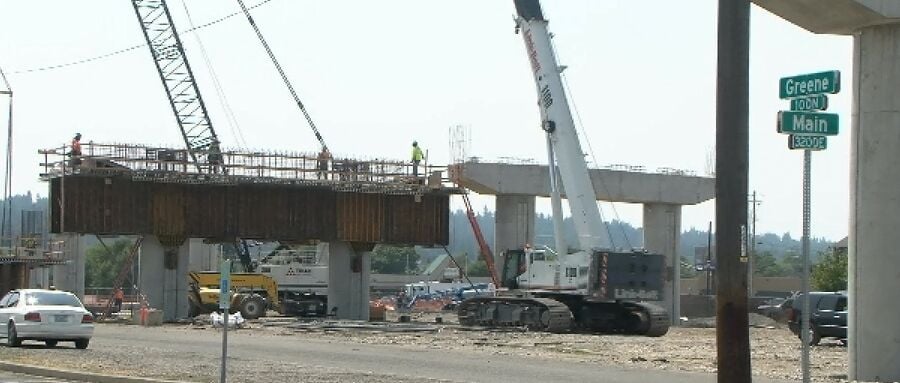
SPOKANE, Wash. — After more than two decades of planning and construction delays, the North Spokane Corridor is showing tangible signs of progress. Visible construction activity — including newly erected support columns and concrete pouring — demonstrates that the long-awaited highway expansion project is moving closer to completion.
The project, which began in 2001, has faced numerous funding interruptions over the years. However, the Washington State Department of Transportation confirmed the corridor is now fully funded through completion.
“Funding has been interrupted several times and that has caused pauses on the project. The good news though is that we are fully funded for completion at this point and we’re looking at completion at some point in the early 2030s,” said Nicole LaGoo, with the Washington State Department of Transportation.
Currently, construction crews are working on the section between the Spokane River and Sprague Avenue. That work includes: building the Spokane River crossing, which will be completed this fall; constructing an interchange at Trent; and extending the freeway from where it currently ends at Spokane Community College all the way to Sprague Avenue.
“As they get closer here more south to I-90, they’re just progressively moving along. So right now, those columns, those piers, those are in. They are going to be installing cross beams and garters and then eventually getting to that deck pouring phase across the entire part here,” LaGoo explained.
Near Greene Street and Sprague, where the corridor will pass through, support beams have been erected just off Sprague Avenue. The existing I-90 is located approximately 200 to 300 yards away from the current construction site, and connecting those two sections represents the next major phase of the project.
“The next portion that drivers will actually be able to drive on and will be open to the public is going to be Wellesley to Trent and that’ll open in the next two to three years,” LaGoo said.
For residents who have watched this project develop over the past two decades, the visible construction milestones — from the rising columns to the expanding concrete sections — signal that the long-anticipated corridor is finally becoming a reality. Once fully completed in the early 2030s, the project will provide improved traffic flow and connectivity in the northern part of the city.
COPYRIGHT 2026 BY KXLY. ALL RIGHTS RESERVED. THIS MATERIAL MAY NOT BE PUBLISHED, BROADCAST, REWRITTEN OR REDISTRIBUTED.