SPOKANE, Wash — In August 1910, a catastrophic fire spread from the Idaho Panhandle into eastern Washington and western Montana, becoming the largest wildfire in American history.
Known as “The Big Burn,” “The Great Fires,” or “The Big Blow Up,” this disaster transformed the landscape of the Inland Northwest and established how America fights fires today.
The fire consumed approximately 3 million acres — an area roughly the size of Connecticut — and killed 87 people, 78 of whom were firefighters.
Jack Kredell, a researcher at the University of Idaho who specializes in this topic, said the conditions in 1910 created extreme circumstances for disaster.
“1910 was truly anomalous. It was very dry. A dry spring gave way to a very dry summer and then there are accounts of hurricane force winds,” Kredell said.
At the time, thousands of small fires started by railroads, logging camps and lightning burned across the region. Before they could be contained, hurricane force winds on August 20th whipped the small fires into one massive firestorm.
“So that’s when those fires really peaked and became this massive, catastrophic fire or collection of fires that burned around 3-million acres,” Kredell explained.
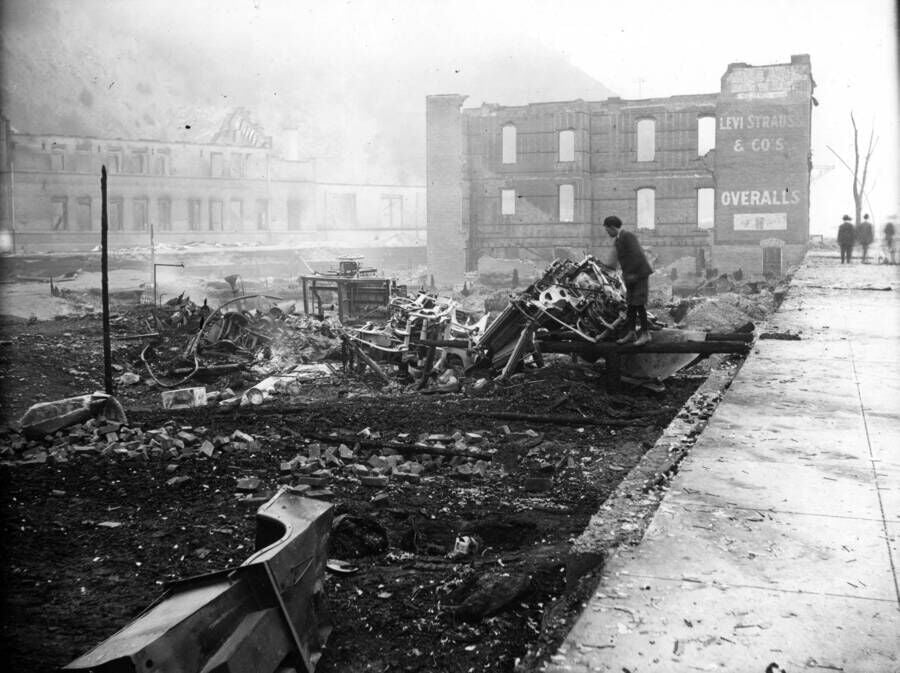
The fire destroyed forests and entire communities. In Wallace, Idaho, photos show the town in ruins. The only wooden building left standing was the 6th Street Theater, which remains in downtown Wallace today.
Charlie Roberts, executive director of The Historic Wallace Photo Museum, said the fire’s impact is still visible in the town’s architecture.
“It’s the reason downtown looks the way it does. That’s the reason everything in that business district is brick now,” Roberts said.
Among the many stories of tragedy and heroism from The Big Burn, perhaps none is as remarkable as that of Ed Pulaski, who saved a 45-man firefighting crew near Wallace by leading them into a mine shaft. There, they took refuge as the fire passed over them.
Today, visitors can hike a trail named in Pulaski’s honor near that exact spot. He is also credited with creating a fire axe called “The Pulaski” that firefighting crews still use today.
The natural disasters’ legacy extends far beyond individual acts of heroism. The Big Burn is largely credited with establishing modern fire management practices.
“The big burn kind of reveals a path for the forest service and the history of the 20th century, at least in terms of fire management, was largely a product of that first encounter with large wildfire,” Kredell said.
The disaster led to the passage of the Weeks Act, which allocates federal money to states for firefighting efforts. It also highlighted the importance of maintaining land through controlled burns — something Kredell believes could still be improved in modern firefighting efforts.
Kredall noted that indigenous people had actively managed these forests for centuries before being displaced, and their absence contributed to the fuel buildup that made The Big Burn so devastating.
“Indigenous people actively managed these forests for centuries and when those people were displaced the forest was not burned as much and so there was already a lot more fuel when the big burn happened,” he said.
He emphasized that prescribed fires remain crucial for preventing similar disasters.
“Doing a lot more prescribed fire is one way to make sure things like the big burn don’t happen again because they definitely can,” Kredell said.
The Big Burn scarred the landscape of the Inland Northwest, but it also provided important lessons that helped shape America’s approach to wildfire management. More than a century later, the disaster’s influence continues to guide how the nation prepares for and responds to wildfires.
COPYRIGHT 2026 BY KXLY. ALL RIGHTS RESERVED. THIS MATERIAL MAY NOT BE PUBLISHED, BROADCAST, REWRITTEN OR REDISTRIBUTED.