SPOKANE, Wash. — “How many store bags did you use?” is the question replacing the old “paper or plastic?” in Washington. For years, shoppers have been paying for bags at grocery stores, convenience stores, and fast food restaurants.
Washington implemented a single-use plastic bag ban starting in 2023, aiming to reduce plastic waste by encouraging shoppers to bring reusable bags or buy thicker plastic bags that could be reused multiple times.
Globally, people use between 500 billion and 1 trillion plastic bags annually. In the U.S., more than 100 billion plastic bags are used each year averaging more than 300 bags per person.
A study led by Eric Jessup, research professor at Washington State University’s School of Economic Sciences, commissioned by the Departments of Commerce and Ecology, reveals some eye-opening findings. To offset environmental costs, reusable plastic bags need to be used between 7 and 12 times compared to thinner single-use bags.
“It’s just not happening,” says Professor Jessup regarding the reuse of thicker bags.
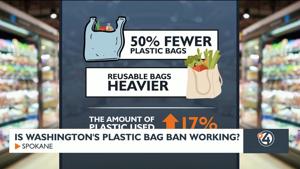
Shoppers are using 50% fewer thicker reusable bags, but since these bags are heavier, the overall amount of discarded plastic waste has not decreased. In fact, plastic usage has increased by 17%, contrary to the law’s intent to reduce plastic waste.
The Departments of Commerce and Ecology issued a memo criticizing WSU’s study for lacking robust data. Professor Jessup acknowledges the limitations but stands by the findings stating that the research is publicly available for review and replication.
The 2020 law scheduled a price increase for plastic bags from 8 cents to 12 cents starting January, 2026. Researchers agreed with that upcharge. The law also planned an increase in plastic bag thickness, almost doubling it. WSU researchers did not agree with that. The state delayed increasing bag thickness for two years.
We tried to obtain interviews with representatives from the Departments of Commerce and Ecology regarding the study, but were not successful.
Washington’s plastic bag ban may have changed shopping habits on the surface, but the environmental impact appears to be more complex. The question remains: Are reusable bags truly reducing waste, or just shifting the problem?
Note: For further reading, here is Washington State University’s plastic bag ban study and official memo from Washington’s Departments of Commerce and Ecology.
COPYRIGHT 2025 BY KXLY. ALL RIGHTS RESERVED. THIS MATERIAL MAY NOT BE PUBLISHED, BROADCAST, REWRITTEN OR REDISTRIBUTED.