SPOKANE, Wash — There is a special tool behind one of the many doors at Shriners Children’s in Spokane.
The Motion Analysis Center is a unique resource that helps kids better understand how their bodies move and how doctors can assist them in moving more effectively and without pain.
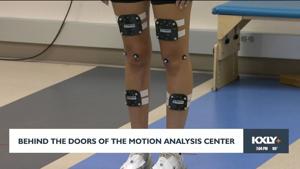
“It’s always fun and interesting to see a bunch of little dots all over you,” said 18-year-old Lainee Martin.
Lainee had been living with chronic knee pain for years—something you don’t typically see from an active high school cheerleader.
“I noticed a lot of pain, so I started PT and noticed it was building my strength a lot, but it wasn’t helping with my pain,” said Lainee.
Her pain interfered with her life, something her mom saw firsthand.
“My kid won’t take my car to the mall to go shopping with her friends because it hurts to walk from the parking lot to the store,” said Missy Martin, Lainee’s mom. “Se like bailed, like I’m done. I can’t do this anymore. It hurts Mom. I’m like, okay, this girl loves to shop. Something is not right here.”
Lainee did a study at the Motion Analysis Center at Shriners, hoping to find answers to her pain.
The room is filled with cameras that capture a 360-degree view of the patient through reflective dots placed all over the body.
The dots then help create a 3D model of a patient walking, running, or simply stepping.
The dots track your every movement, and doctors are then able to fully understand why someone may be feeling pain or not walking quite right. Information you can’t get with the naked eye.
“They did a study on me and noticed I had inward knees and I wasn’t walking correctly,” said Lainee.
In Lainee’s case, it had to do with the way her bones grew and required surgery to fix—something she may not have ever discovered without this technology.
Shriners Spokane is the only hospital in our region with a Motion Analysis Center, and people from other states and counties come here specifically to use it.
However, Shriners is unique in the fact that it has this technology in 14 other hospitals in the US and Canada, and is helping kids from coast to coast.
“It’s really nice to see where things are coming from,” said Jenna Gerber, a physical therapist with the Motion Analysis Center. “So with my naked eye, I might be able to see your knee is pointing in or your trunk leaning over or something, but it’s really nice to get all this information to see. Is that compensation or the main problem?”
Jenna worked on Lainee’s study, but she has also helped many other kids with a variety of conditions.
“Maybe they have clubbed feet or they have cerebral palsy or, like Lainee, we saw there was an issue with the growth of her bones, a torsional issue or a bending issue,” said Jenna. “Some of our kids, too they don’t even have a diagnosis yet, so this can actually be a very helpful tool as the family is trying to gather extra information. If their doc is trying to go after it and we don’t know exactly what is going on with your kid, we can add another piece to their puzzle.”
For Lainee, the answers found in the center are setting her up for a pain-free future.
She underwent her first knee surgery earlier this year and is gearing up for the same surgery on her other leg in a couple of months.
“I feel more correct. Now, especially after the surgery, I feel like walking is easier and getting better, and I can definitely feel the difference between my walking,” said Lainee.
A huge relief for not only Lainee, but her family and care team, who had been working to find these answers for years.
“As a parent, it was really nice to have some answers for possible things that were causing her pain,” said Missy. “To hear her tell the doctor like ‘I feel good’ and I’m like ‘oh my god’.”
Feeling good as she walks into her next chapter of life, all thanks to the work at Shriners.
To learn more about the Motion Analysis Center, click here.
COPYRIGHT 2025 BY KXLY. ALL RIGHTS RESERVED. THIS MATERIAL MAY NOT BE PUBLISHED, BROADCAST, REWRITTEN OR REDISTRIBUTED.