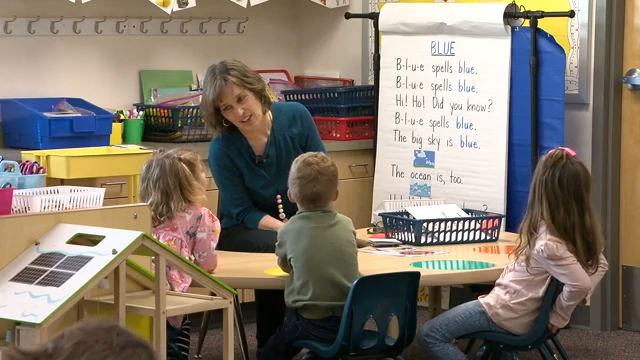
NINE MILE FALLS, Wash. — Washington’s $16 billion budget shortfall is threatening Transition to Kindergarten (TK) programs that serve thousands of preschool-aged children across the state.
Despite their popularity and effectiveness, TK programs are encountering opposition in Olympia during this legislative session.
TK is a no-cost option for public preschool in Washington state. This program differs from private preschools, Head Start, or Early Childhood Education and Assistance Program (ECEAP) classrooms because it’s accessible to more families regardless of income.
Representative Sharon Tomiko Santos, who co-sponsored House Bill 1450 to limit TK programs, expressed concerns during a legislative session meeting: “We don’t have access if there’s a free opportunity, we can’t keep those 4-year-olds in our classrooms.”
Santos argues that the program “was quickly developing into a program under the superintendent with no guardrails.” She points to districts where TK programs have opened and ECEAP programs have subsequently lost students.
However, Santos acknowledges exceptions exist for districts like Nine Mile Falls, which are considered “extreme childcare deserts.”
“You have children who are in need, but you don’t have the partners to be able to provide the need, so that is what we are defining as an extreme childcare desert,” Santos said.
The most recent data reveals the significant disparity in early education access: more than 65% of preschool-aged kids (3-5 years old) in Washington aren’t attending state-funded preschool, according to the Washington Department of Children, Youth, and Families.
As of February 2025, 7,800 students were enrolled in TK programs across 158 districts statewide, according to the Office of Superintendent of Public Instruction (OSPI). The same report indicates that TK students tested in fall 2024 demonstrated better kindergarten readiness scores compared to peers without such preparation.
Another bill (SB 5769) moving through the legislature would limit access to TK but maintain funding for current programs. While this approach might work for some districts, Nine Mile Falls could face significant challenges in the coming years as the community grows.
The area is set for substantial growth with former recreational spaces like Sun Dance Golf Course, being converted to a residential development with 475 lots for single family residences.
Nine Mile Falls Superintendent Jeff Baerwald emphasized that access to these programs addresses a critical need.
“The reality is that there are so many childcare deserts in our state, there’s just a lack of services,” Baerwald said.
Nine Mile Falls currently has one licensed part-time preschool, that serves approximately 9 students.
For Rachael McKinney, a working mother of two and parent volunteer in her daughter’s TK classroom the program has been transformative.
“She’s counting to 100, she’s counting by tens, she’s barely five!” McKinney said about her daughter’s progress.
Transportation is also significant for families in outlying districts.
“Now they both get to ride the bus together, they get picked up at our driveway, dropped off at our driveway,” McKinney adds, comparing it to her previous routine of driving her son into Spokane daily when he turned four.
Nine Mile Falls, Freeman, Mead, and several other school districts in Eastern Washington have expanded access to early learning through TK programs. These programs provide an alternative for families who may not qualify for the Early Childhood Education and Assistance Program (ECEAP) or Working Connections Child Care subsidy, or who cannot secure spots on waitlists at private early learning centers.
“These parents have this access right now and taking that away is a huge detriment to our kids,” said Heather Gamboa, the principal at Nine Mile Falls Elementary.
The potential limits to TK programs follow a series of budget-related reductions to Head Start and ECEAP programs that 4 News Now has reported on earlier this year.
COPYRIGHT 2025 BY KXLY. ALL RIGHTS RESERVED. THIS MATERIAL MAY NOT BE PUBLISHED, BROADCAST, REWRITTEN OR REDISTRIBUTED.